In Ukraine, so far, intermediate and cover crops have been grown for further use as green manure or for feed production. The usage of intermediate and cover crops for biomethane production emphasizes an innovative approach, which requires a thorough analysis of feasible opportunities and prerequisites for successful implementation within Ukraine’s context.
As part of the project “Ukrainian Biomethane Sector Development” UABIO experts have prepared an important Analytical Note No. 1: Advanced biomethane production from intermediate and cover crops, which covers all the necessary information on the cultivation of intermediate and cover crops in Ukraine and the further use of these plants for biogas and biomethane production. In particular, this document examines the impact on soil resulting from the use of such biomass for the production of biomethane.
Benefits for the soil
One of the most important aspects of the sustainability of biomass as a feedstock for biofuels is the absence of competition with food and feed production. In the case of the use of intermediate and cover crops for energy, an important question is also to what extent these crops change their traditional agronomic functions such as soil protection from erosion, improvement of soil quality etc.
Results of theoretical studies by European experts (2022) indicate that the use of cover crops for biogas production with subsequent application of digestate to the field has a positive effect on carbon accumulation in the soil and reduction of CO2 emissions from the soil.
If we assume the organic carbon content (Сorg) in the aboveground part of a cover crop at 100 units, then its balance when incorporating biomass into the soil is -4 to 28. In the case of anaerobic fermentation of the aboveground biomass of a cover crop with the return of digestate to the field, the organic carbon balance is positive at the level of 9-29. At that, the cover crop continues performing its traditional ecological functions (protection of soil from erosion, etc.), and the risk of negative impacts is low.
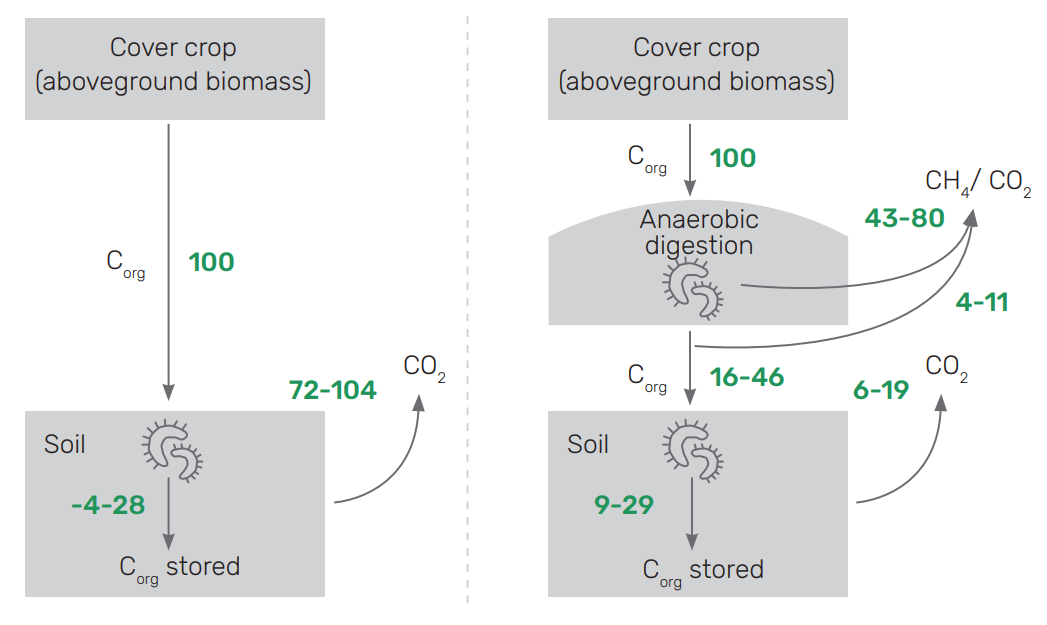
Carbon balance in case of incorporating the aboveground biomass of a cover crop into the soil and in case of returning the cover crop digestate to the field. Source.
Austrian research
Austrian experts conducted more than 5-year field research of the impact of growing and using cover crops for biogas production on soil and groundwater (Syn-Energy project 2010-2015). Five cover crop options were investigated, most of which were mixtures of at least 3 plant species with 50% legumes.
Results of the study showed that when harvesting biomass of cover crops with a yield of 2.5 t d.m./ha with the return of an equivalent volume of digestate to the field, the humus carbon input to the soil is 112 kg/ha. If the same cover crops are applied to the soil as green manure, the humus carbon input is only 80 kg/ha. The higher the biomass yield per hectare is, the higher the positive effect on humus content is. When growing cover crops for biogas, the volume of biomass is bigger due to early sowing and late harvesting. Compared to fallow, the risk of erosion is reduced by 50% by growing cover crops for biogas production. For cover crops used as green manure, this effect is lower.
French research
Positive results regarding the preservation of soil carbon stocks were also obtained when modelling examples of growing cover crops as feedstock for a biogas plant with the return of digestate to the field in France. Four examples were studied in different regions of the country:
- Ile-de-France (Paris area, Oceanic climate, Luvisol soil type);
- Southwest region (Oceanic to Mediterranean climate, Luvisol and Calcisol soil types);
- Rhône-Alpes (central to South-eastern France, Semi-continental climate, Luvisol soil type);
- Western France (Oceanic climate, Cambisol soil type).
Presented in literature research results are given mainly for the Ile-de-France region (1st crop rotation option), so these data are presented below. In total, three crop rotation options with different cover crops were considered for Ile-deFrance.
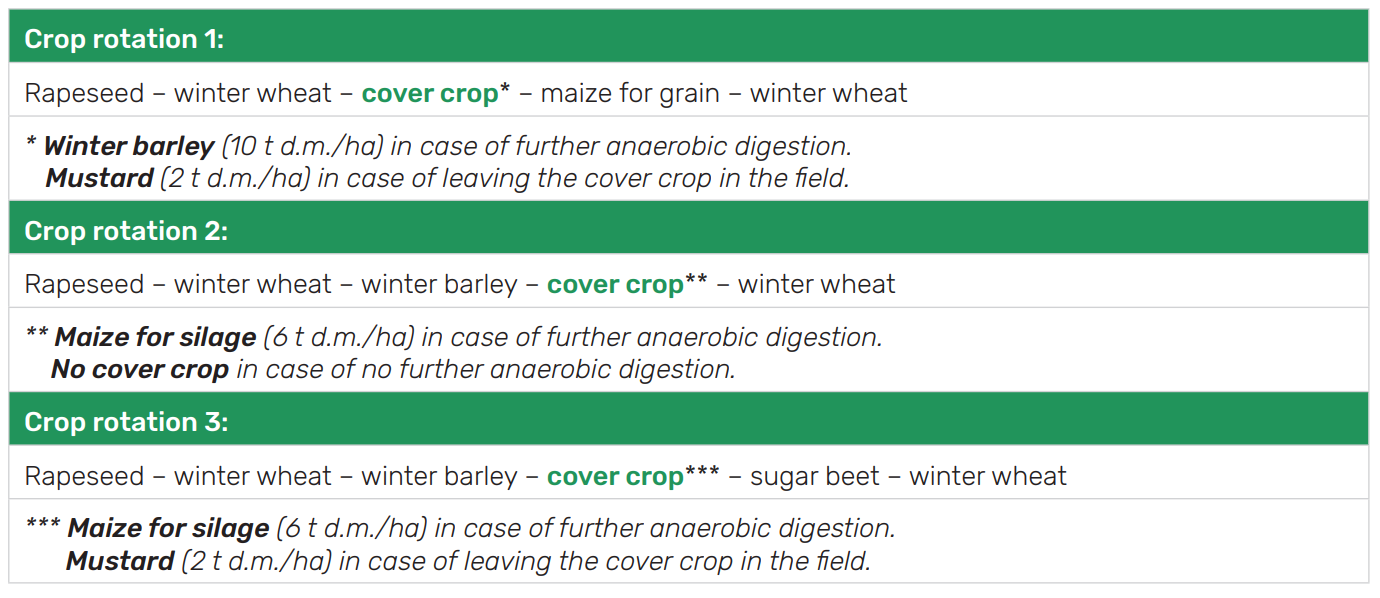
Crop rotation options with cover crops investigated for Ile-de-France region. Source
In France, the most common cover crop that remains in the field is mustard (Sinapis alba). It is usually sown from mid-August to mid September, and incorporated into the soil from November to January. Winter barley (sowing in autumn, harvesting in spring) was the cover crop for obtaining feedstock for a biogas plant in crop rotation option 1.
It is assumed that in all the crop rotation options, the entire volume of crop residues of the main crops is returned to the soil. It is determined that the main annual amount of humified carbon enters the soil with the above-ground part of the plant residues, and in the case of leaving the cover crop in the field, this volume is larger.
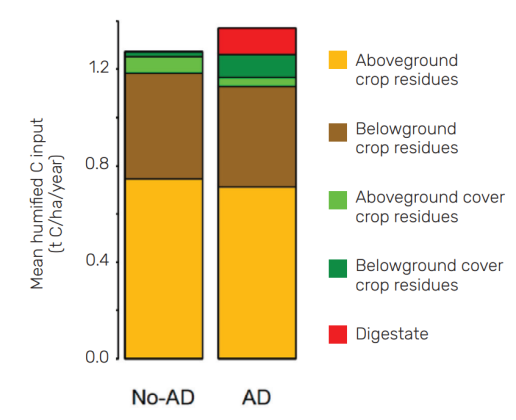
Mean yearly humified C input for no-AD and AD scenarios for the Ile-de-France region. Source
However, the total annual amount of carbon input into the soil (main crop residues, cover crop residues, digestate) is higher in the case of growing the cover crop as a feedstock for a biogas plant with the digestate returned to the field: 1.37 t of humified carbon/ha/y versus 1.27 t of humified carbon/ha/year when incorporating the cover crop biomass into the soil.
Simulation of the soil condition over 30 years shows that organic carbon content could increase from 50 t C/ha (baseline) to 50.5 t C/ha under cover cropping with digestate return. In the alternative scenario (remaining biomass in the field), organic carbon content could decrease to 49.4 t C/ha.
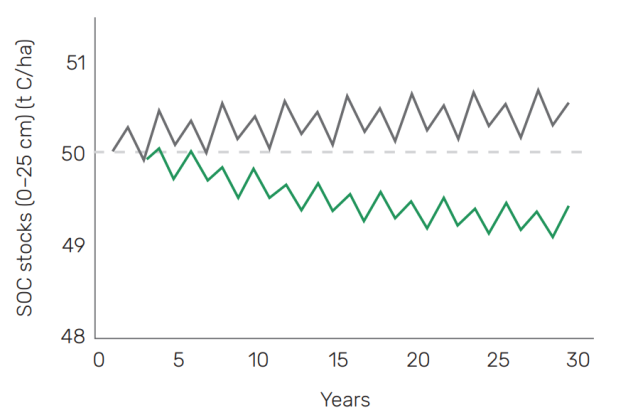
Simulated SOC stock (0-25 cm) evolution for no-AD and AD scenarios for the Ile-de-France region. Source
Read the full text of Analytical Note No. 1 on the UABIO website.
The analytical note was prepared within the framework of the project “Ukrainian Biomethane Sector Development”, funded by the Energy Community with the support of the UK Agency for International Development (FCDO) and implemented by the Public Union “Bioenergy Association of Ukraine” (UABIO). We would like to thank the experts at UABIO for preparing this document!