The World Bioenergy Association has recently published its annual report ‘Global Bioenergy Statistics. 12th edition. 2025’. It focuses on the global development of energy production from biomass. The data are presented at different geographical levels – global, continental and regional, covering all bioenergy sectors – liquid biofuels, biogas, pellets, forestry, agriculture, waste, etc.
Below are some of the key findings from the 2025 report. The document can be downloaded here.
Total Energy Supply
Global energy supply reached a record 622 EJ in 2023. Fossil fuels continue to lead, delivering over 80% of the total supply. Renewables also hit a new peak at 92 EJ, increasing by 3% year-on-year. Bioenergy played a central role, contributing 56 EJ or about 9% of global energy supply.
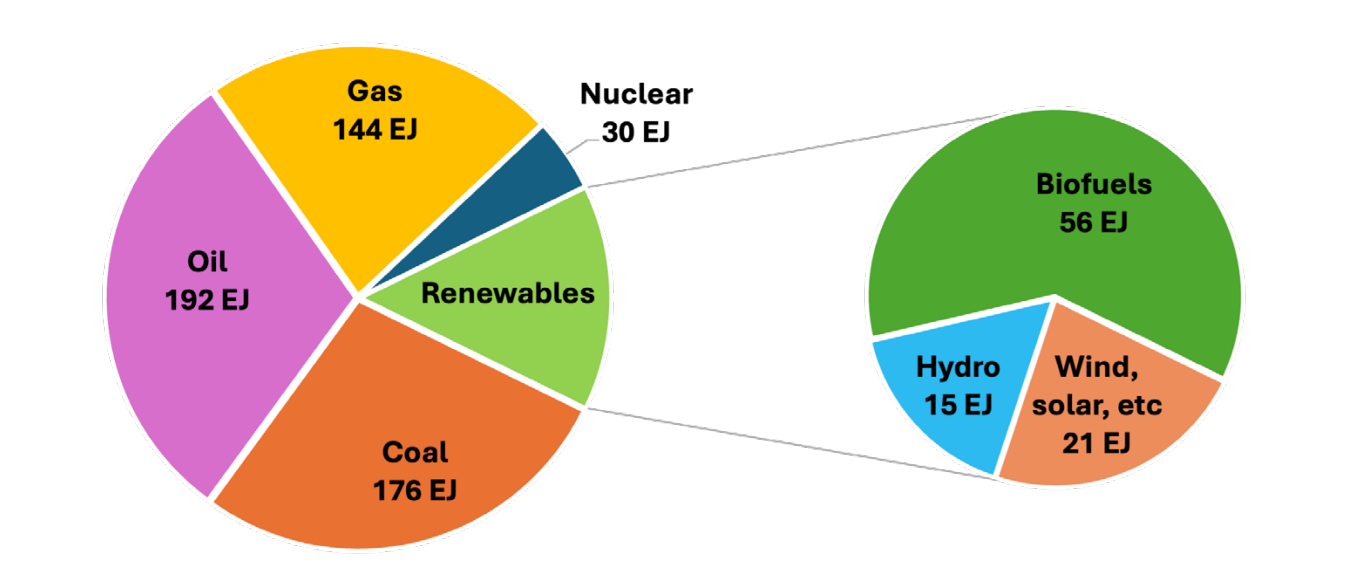
Global Total Energy Supply in 2023. Source: IEA.
Electricity
Renewable electricity generation reached 9,836 TWh in 2024, marking a 10% increase compared to 2023. Hydropower remained the largest source, accounting for 45% of total renewable electricity generation. Solar power showed the fastest growth with a 28% year-on-year increase, while bioenergy continued its steady expansion, rising by 3% reaching 698 TWh in 2024.
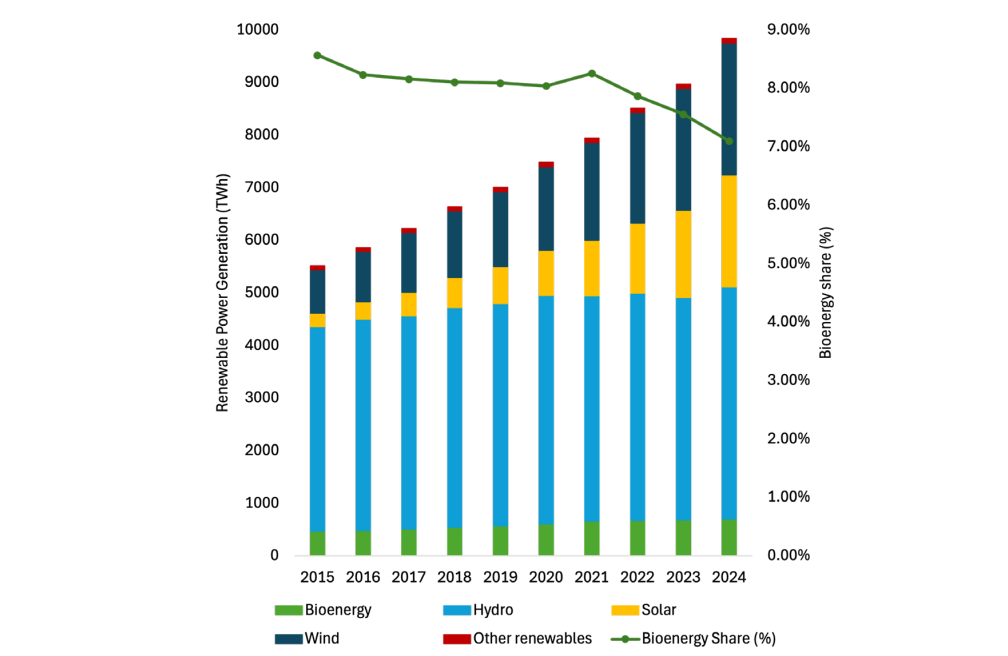
Global Renewable Electricity Generation. Source: Ember.
At a regional level, Asia had the highest contribution to renewable electricity generation, accounting for 48% of the total global output. Bioenergy grew the largest in Africa, with a 40% increase from 2023 to 2024, reaching 4.41 TWh, maintaining only 1.84% of its renewable electricity mix, while in Europe, bioenergy accounted for 10% of the renewable power generation in 2024.
Heat
Global renewable heat production reached 1.64 EJ in 2023. Bioenergy remained the dominant source, providing 73% of the total. Bioenergy’s share in heat generation has steadily declined from 87% in 2014 to 73% in 2023.
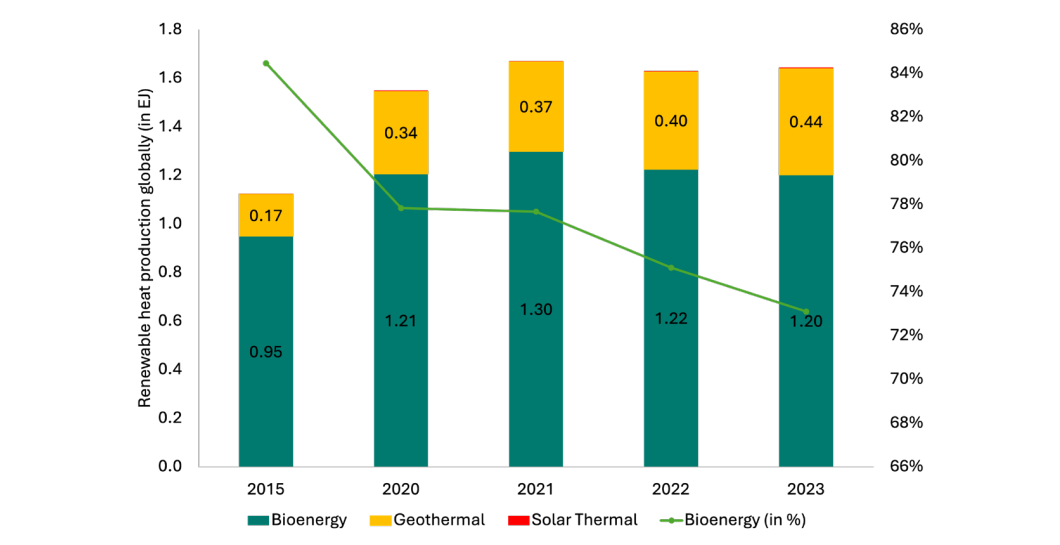
Global Renewable Electricity Heat Production. Source: IEA.
Transport
Energy use in the road transport sector reached just over 92 EJ in 2023, surpassing pre-pandemic levels for the first time. Fossil fuels are still the largest source of energy, increasing 3% in 2023.
Within the renewable sources, biofuels remain the largest, accounting for 4.7EJ in 2023, 4% of total transport energy, and 89% of all renewable alternatives. Additionally, biofuel consumption increased by 12% in 2023, marking the largest rise in more than a decade.
As of 2025, at least 37 countries had adopted and/or announced biofuel blending mandates, while only four countries (Canada, India, Brazil, and Vietnam) introduced direct fiscal or financial incentives to support biofuels in the transport sector.
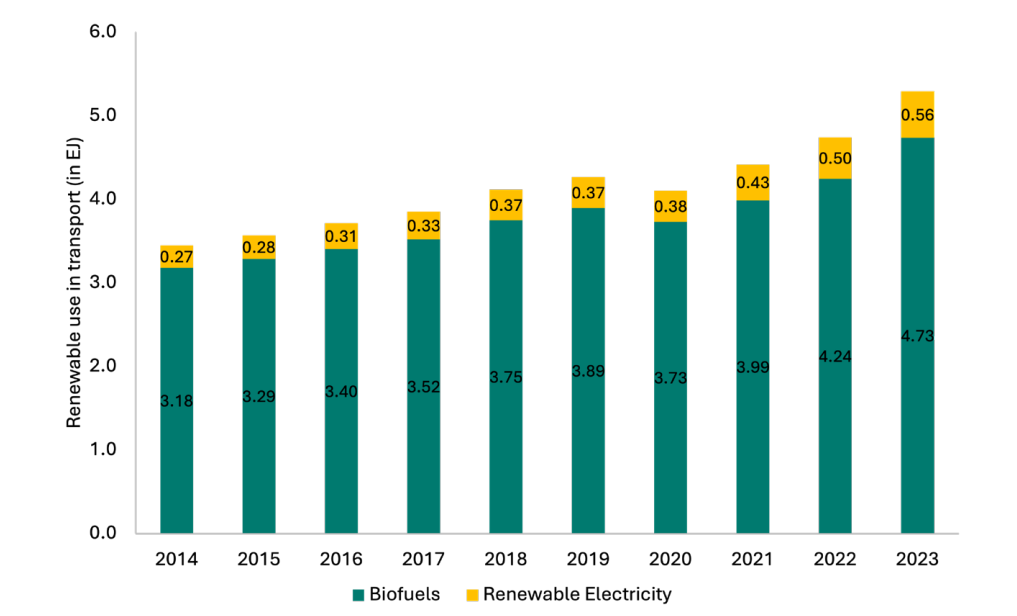
Renewable Energy Use in Transport. Source: IEA.
At a continental level, the Americas dominated renewable transport energy consumption with 3 EJ, of which 98% came from biofuels, with Brazil and the United States the main contributors in the region. Asia and Europe followed, each contributing around 1.0 EJ, with biofuels representing 76% and 85% of their respective totals. In the European Union, renewable energy use in transport grew by 6% between 2022 and 2023, largely supported by higher biofuel consumption.
Biomass Supply
In 2023, the global domestic supply of biomass totalled 56 EJ, a 2% increase compared to the previous year. Solid biomass remained the largest type of biomass, accounting for over 83% of the supply. By contrast, biogas and liquid biofuels have shown steady gains, with biogas rising to 1.72 EJ and liquid biofuels reaching nearly 5 EJ in 2023, both recording their highest levels over the past five years.
Woodfuel
In 2023, more than 1.7 billion m3 of wood fuel were produced globally. Africa and Asia led the global production with shares of 42% and 35% respectively. Americas with 16%, and Europe followed with 6%.
Wood Charcoal
Global production increased by nearly 2% in 2023, primarily driven by rising output in Asia. Total production in Asia increased by 12% in 2023, with India, Thailand, and China as the biggest producers in the region.
Wood Pellets
In 2023, global wood pellet production saw a small reduction compared to 2022, from 48.1 to 47.1 million tons. Europe leads the production by contributing about 24 million tons, more than half of global production. Germany remained the top producer in Europe, responsible for nearly 15% of the region’s output
Agricultural Crops
Agricultural residues play a crucial role in bioenergy production, providing essential feedstocks for various bioenergy applications. As the demand for renewable energy grows, agro residues are increasingly recognized for their potential to contribute to climate and energy goals.
Over the next decade, global production of ethanol and biomass-based diesel is projected to expand, with crops expected to remain the primary feedstocks. Ethanol production continues to rely mainly on maize and sugarcane, while biodiesel is largely based
on vegetable oils and used cooking oil.
Wheat
Wheat used for biofuels accounts for about 8 million tonnes annually, or roughly 1% of global production. This indicates that the role of wheat in biofuel supply remains limited compared to its importance as a staple food crop, and its contribution to energy markets has not required significant changes in yields or harvested areas. In 2024, it is estimated that ethanol production from wheat was slightly higher than 3 billion liters globally.
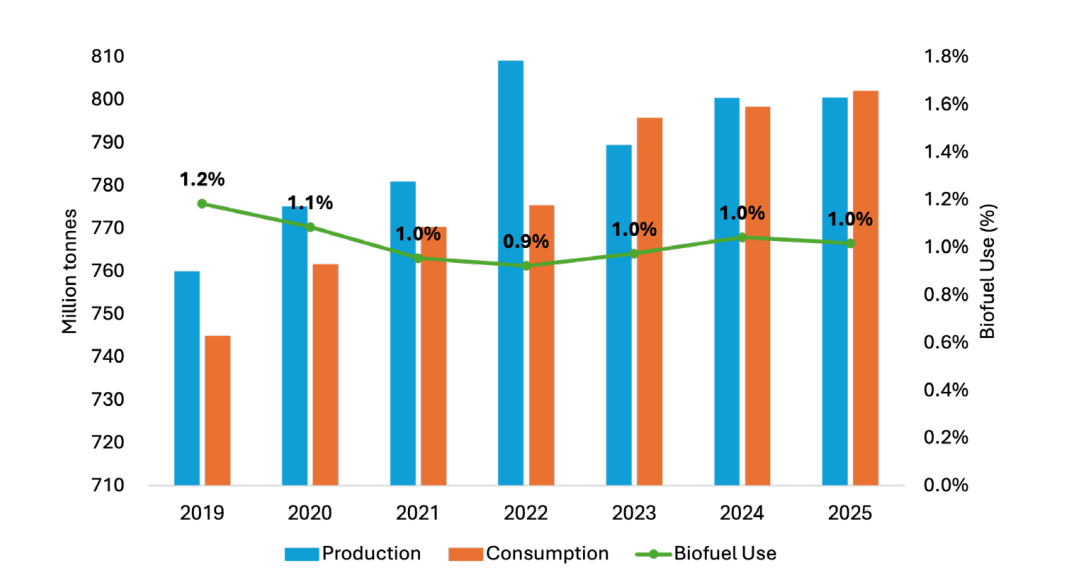
Global Wheat Production, Consumption, and Biofuel Usage. Source: OECD-FAO.
Maize
Maize continues to be the leading feedstock for ethanol production, with the United States and China producing 62 and 8 billion liters, respectively, in 2024. Over the past five years, maize use for biofuels has grown by about 11 percent, while the harvested area has remained stable.
Vegetable Oils
Vegetable oils, including palm, rapeseed, and soybean oils, are crucial for biofuel production around the globe. Since 2019, the use of vegetable oils for biofuels has increased by over 40%, matching the rise in global biodiesel production.
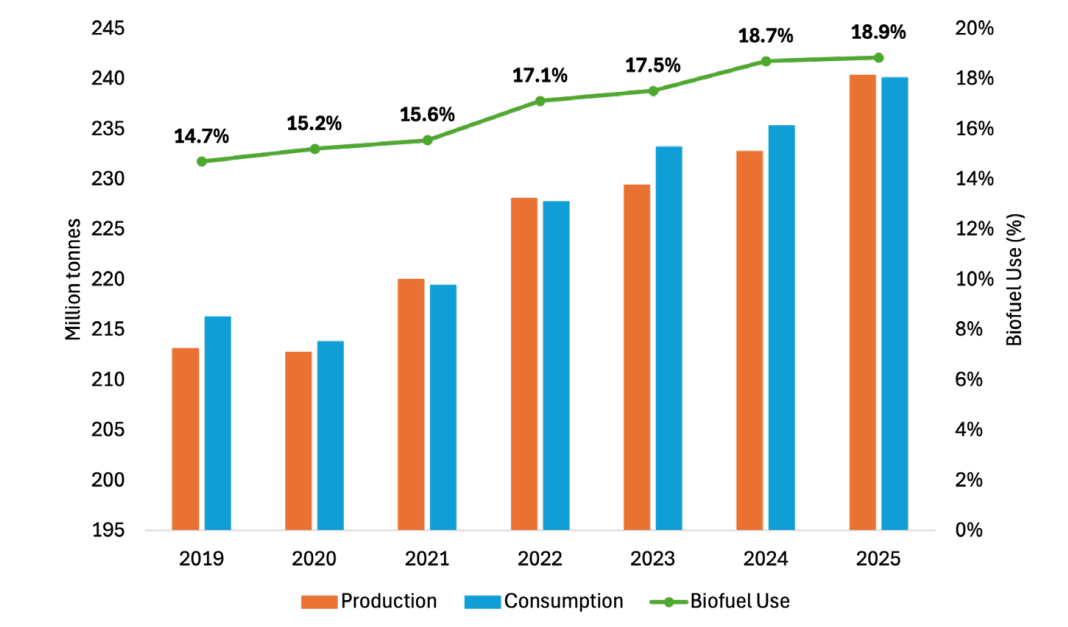
Global Vegetable Oils Production, Consumption, and Biofuel Usage. Source: OECD-FAO.
Waste to Energy
Energy supply from municipal and industrial waste increased steadily from 2.27 EJ in 2014 to 2.71 EJ in 2023. In 2023, total generation fell slightly compared to 2022, mainly due to a 2% decrease in municipal waste output, while industrial waste continued to rise marginally.
Bioenergy
Bioelectricity
Bioelectricity generation peaked at 698TWh in 2024, with a 2.96% growth rate yearon-year basis. Asia remains the largest producer with 343 TWh, representing nearly half of global output.
However, growth in the region has slowed to its lowest level since peaking in 2021, reflecting a combination of slower capacity additions in China and India. In Europe, generation rose by 2% year-on-year, supported by stable demand for power, yet output remains below the higher levels recorded in 2021.
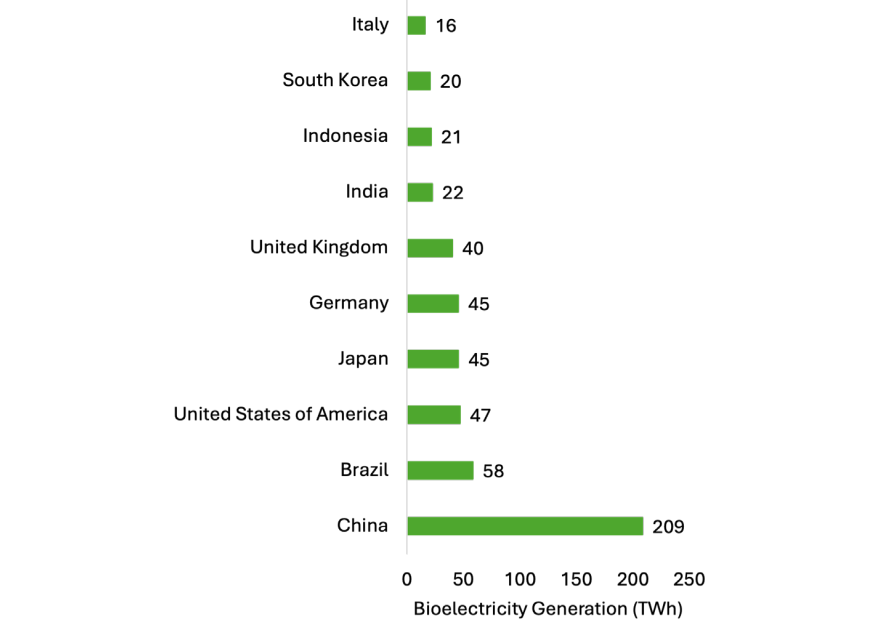
Top 10 Countries with the Largest Bioelectricity Generation in 2024.
Bioheat
In 2023, global heat production from biomass reached 1.2 EJ, with solid biomass accounting for more than half of the total. Over the past five years, total bioheat production has remained relatively stable, fluctuating between 1.17 and 1.30 EJ.
Biofuels
Global liquid biofuel production reached a record 192 billion liters in 2024, an 8% increase from 2023, continuing its steady rise over the past decade. Ethanol remains the largest biofuel produced at 121 billion liters, largely sustained by the United States and Brazil. Biodiesel (FAME) output peaked at 50 billion liters, while renewable diesel (HDRD) emerged as the fastest-growing segment, peaking at 20 billion liters, almost tenfold since 2014. SAF production reached 1.3 billion liters in 2024, doubling the output from 2023. Despite this growth, SAF accounts for only 0.3% of global jet fuel use.
Biogases
In 2023, the generation capacity of biogas and biomethane increased by 4% globally. Global biogas production stood at 1.76 EJ in 2023, while demand reached 0.82 EJ and is projected to continue rising. Growth is expected to be concentrated in Europe and China, which remain the key drivers of market expansion. Despite this progress, production still represents only a fraction of the estimated global potential. The IEA places this potential at around 1,000 bcme (equivalent to 35.8 EJ), with Brazil, China, and India together accounting for about 80%. This highlights a significant untapped opportunity, particularly in emerging markets where large feedstock availability and growing energy needs could accelerate future deployment.
Investments
According to the International Energy Agency (IEA), global investment in the bioenergy sector is expected to increase to more than USD 16 billion in 2025, which is a 13% increase from 2024, and the highest increase on record. Almost half of this figure is for the liquid biofuels sector, which has risen in numbers in 2023 and 2024.
The Global Bioenergy Statistics 2025 report can be found at the link.