On 27 November 2025, the European Commission unveiled a new bioeconomy strategy aimed at boosting circularity, climate neutrality, and competitiveness across the EU. The European Commission’s proposal acknowledges the role of bioenergies and biofuels, as well as the need for flexibility when assessing efficient biomass-use pathways.
This strategy is important for the recognition of biogas plants as biorefineries that produce not only renewable energy, but also two co-products (digestate and biogenic CO2) and innovative derivatives from these streams (e.g., e-fuels, syngas, green hydrogen, bio-based plastics, chemicals and fertilisers, polymers, etc.). This delivers exponential benefits across multiple sectors: renewable energy production, industry defossilisation, sustainable agriculture and environmental sustainability.
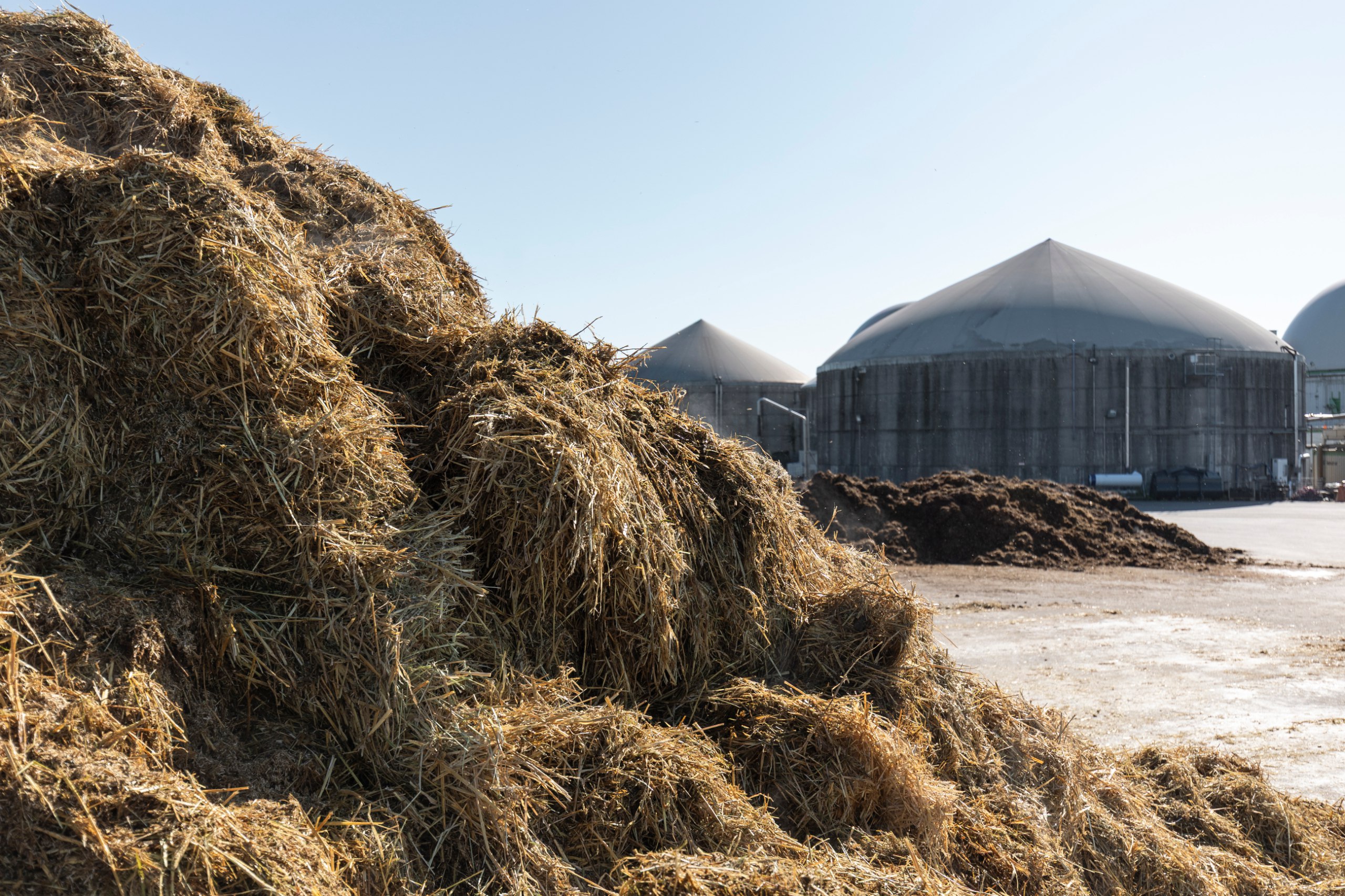
General overview of the EU bioeconomy
The bioeconomy represents a strategic opportunity of the 21st century – a driver of green growth, competitiveness and resilience.
Europe’s bioeconomy has strong foundations: world-class science, cutting-edge technologies, a competitive industrial base, a single market of 26 million companies and 450 million consumers and significant biomass production managed by EU farmers, foresters and fishers.
It is a dynamic driver of competitiveness that is of strategic importance to a wide range of economic sectors. In 2023, biomass producing and converting activities employed in the EU 17,1 million people (8% of EU jobs) and generated EUR 863 billion in value added (5% of EU GDP). R&D investment in bioeconomy-related sectors reached EUR 23.2 billion (9% of all R&D investments) in 2023, while patents in these fields accounted for 5% of all patents filed in EU between 2008 and 2020.
Over the past decade, bioeconomy sectors have grown faster than the overall economy. Estimates suggest that for every job, which is created in the European bioeconomy industry, an additional 2.9 indirect jobs are created in the EU. However, the bioeconomy still has enormous untapped potential. This is due, in particular, to a lack of investment.
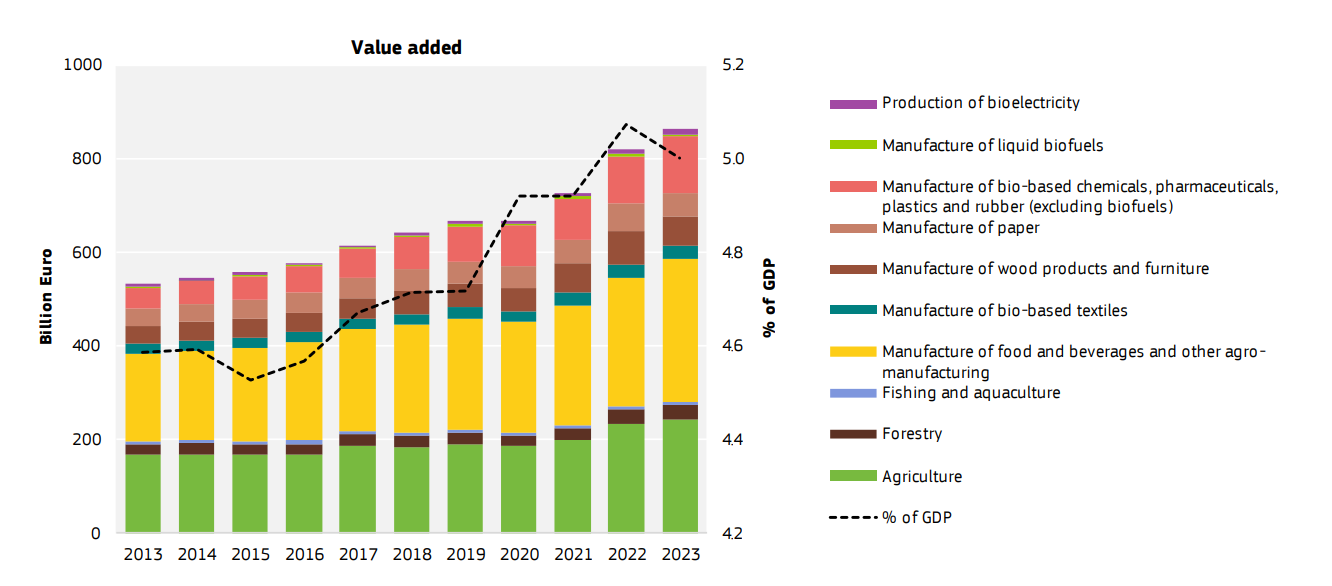
Evolution of value added in the biomass producing and converting sectors (EU27). Source: Lasarte-López, J., M’barek, R. (2025). The EU bioeconomy at a glance: Focus on economic value added, employment and innovation. European Commission, Seville, 2025. JRC143759.
Positive developments
Recognising the potential of biowaste for biogas production is a successful step forward. Another positive step is the Strategy’s focus on biofertilisers as a leading market. Current production of biogases (22 bcm) generates 3 million tonnes of home-grown, nitrogen-based organic fertiliser, covering around 17% of the EU’s current nitrogen fertiliser demand.
These materials can reduce reliance on synthetic inputs (24.2 Mt of fertilisers were imported into the EU in 2024, of which 11.2 Mt were nitrogen-based), support soil health, enable circular value chains, and provide practical solutions for farms.
As highlighted in the Strategy, with the current revision of the Product Environmental Footprint (PEF) methodology, biogenic CO₂ can now be properly accounted for. Today, 127 plants are already valorising biogenic CO2, supplying 1.17 million tonnes of that co-product and meeting approximately 14% of Europe’s demand for merchant liquid and solid CO₂.
Conclusions
The bioeconomy strategy sets out the path to building a sustainable and environmentally friendly bioeconomy by:
- scaling innovation and investments;
- building new lead markets for bio-based materials and technologies;
- ensuring sustainable biomass supply across value chains;
- harnessing global opportunities.
Europe has the knowledge, industrial base and human resources to lead the global transition to sustainable and competitive bioeconomic development. In addition to reducing strategic dependence on fossil fuels and imported raw materials, the bioeconomy also strengthens Europe’s economic and resource security. Implementing this concept will require coordinated action at EU, national and regional levels. The European Commission will report on the implementation of the strategy by 2028.
A strong European bioeconomy is not only an environmental imperative; it is a strategic investment in Europe’s long-term prosperity, resilience and security.
Download documents on the EU Bioeconomy Strategy
Biogas makes an enormous contribution to the circular economy. Biogas and biomethane reduce dependence on fossil fuels in electricity, heat and gas supply. Without their contribution, many EU industries risk slowing down decarbonisation and continuing their dependence on imported fossil fuels. In addition to energy, biogas plants function as modern biorefineries, converting waste into high-value products that directly strengthen the EU’s bioeconomy.